A system is only as useful as its next trial.
From an operating sequence
to a result you can trust.
Robotics brings several kinds of thinking into the same space. A part has a shape and a position. A sensor has a range and a limit. A controller has to make a decision in a sequence that someone can inspect. This program helps you connect those details rather than treating each device as a separate answer.
You begin with mathematics, programming, drawings and electrical fundamentals. Later courses bring programmable controllers, motion, machine vision and reliability into supervised teaching projects. In the final year, a two-part capstone asks your team to define an achievable task, build a bounded prototype and evaluate it against stated criteria.
Plan the sequence.
Translate a task into inputs, outputs, motion and a clear set of operating states.
Integrate the pieces.
Connect controllers, sensing and guarded mechanical movement with documented interfaces.
Test the claim.
Compare repeated trials, record faults and explain what the evidence can and cannot show.
A project with a useful limit.
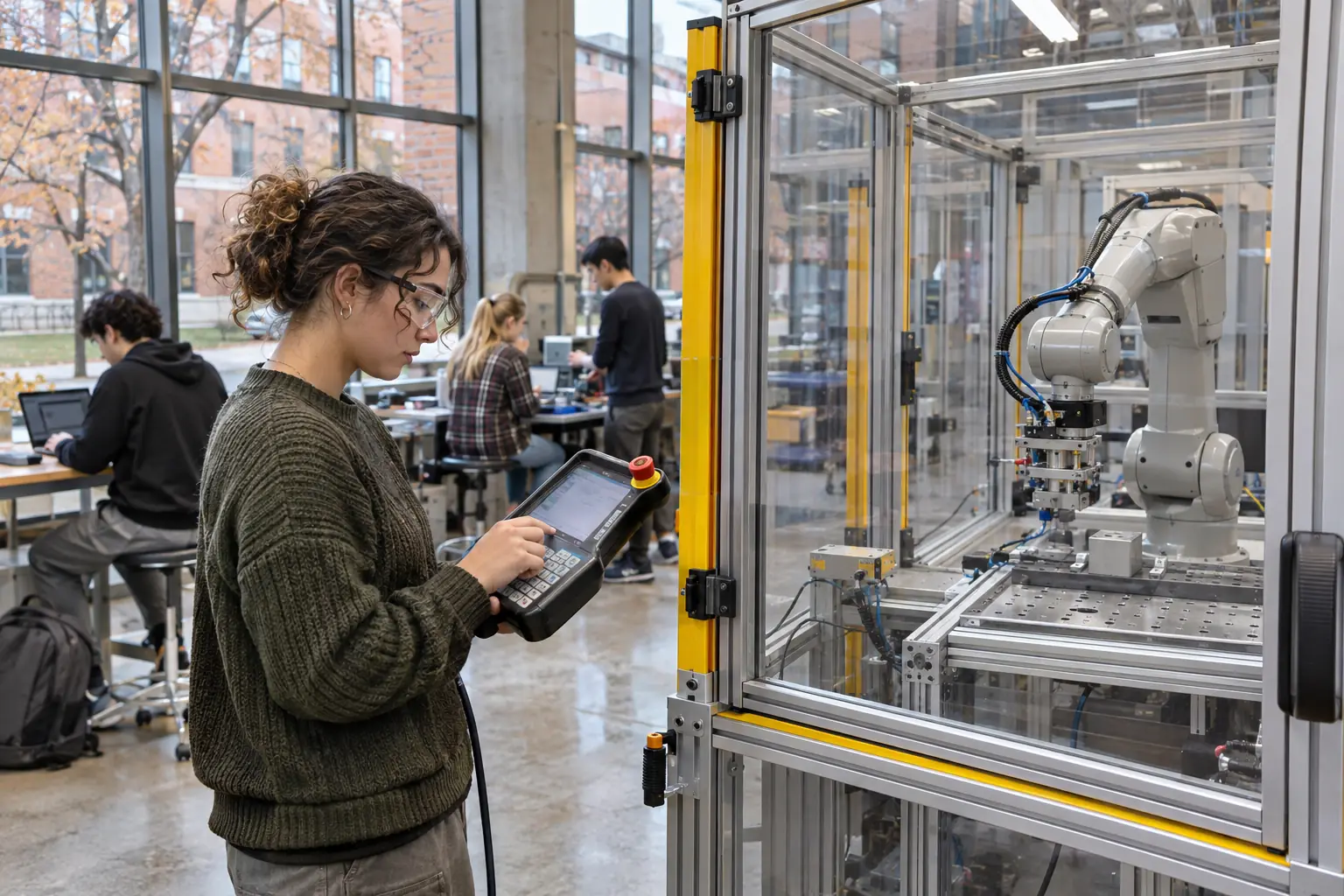
A sample sorting task gives a team something specific to investigate. The challenge is not simply to move a part once. Students compare lighting, orientation and detection decisions, then keep a record of the conditions behind a successful or failed trial.
A pathway project
A guarded sorting cell.
A camera-based check and a simpler sensor arrangement offer different tradeoffs. Teams develop the interface map, test one condition at a time and report missed detections alongside completed cycles. Teaching-cell work takes place only during authorized, supervised sessions.
Your course of study / 2026–27 catalog
A four-year map
with room to connect ideas.
The sample below combines a common academic foundation with robotics coursework and a published concentration-elective selection. General education keeps writing, ethics and an understanding of people and institutions in the degree. Free electives are chosen with an adviser; a course never earns credit twice.
Year 131 credits
Fall semester
Spring semester
Year 232 credits
Fall semester
Spring semester
Year 331 credits
Fall semester
Spring semester
Year 430 credits
Fall semester
Spring semester
Sample sequence, not an individual timetable. Prerequisites, transfer decisions and actual course availability determine your plan. At least 30 of the final 45 credits and both capstones must be completed at Larkmere. Required courses need a grade of C or better; a 2.0 cumulative GPA is required for graduation.
Inside the robotics courses.
Foundational work leads into eight required major courses. The capstone proposal is normally a fall course, followed by implementation and evaluation in spring.
RBT210 · Industrial Robotics
Describe robot motion, work envelopes and teach-pendant workflows using simulation and guarded teaching cells. Students plan a repeatable handling task.
3 credits. Prerequisites: CMP110, ENG110. Typically offered: Fall, Spring.
RBT220 · Programmable Logic Controllers
Develop ladder logic for a controlled training station. Students trace inputs and outputs, sequence operations and document fault conditions.
3 credits. Prerequisites: ENG210. Typically offered: Fall, Spring.
RBT310 · Motion and Control Systems
Model system response and tune basic feedback controllers. Laboratory work uses limited-energy teaching rigs and recorded response data.
3 credits. Prerequisites: ENG220, MAT151. Typically offered: Fall, Spring.
RBT320 · Machine Vision
Acquire images and evaluate features for inspection and positioning. Students compare lighting, calibration and the limits of automated decisions.
3 credits. Prerequisites: CMP120, MAT210. Typically offered: Fall, Spring.
RBT330 · Integrated Automation
Combine robot, controller and sensing functions in a guarded teaching cell. Teams develop an interface map and a commissioning checklist.
3 credits. Prerequisites: RBT210, RBT220. Typically offered: Fall, Spring.
RBT340 · Automation Reliability
Analyze downtime, faults and maintenance records for an automated process. Students propose changes using evidence from repeatable trials.
3 credits. Prerequisites: RBT220, MAT220. Typically offered: Fall, Spring.
RBT401 · Robotics Capstone I
Develop an automation proposal with layout, interfaces and evaluation criteria. Teams review the operating sequence before implementation.
3 credits. Prerequisites: RBT310, RBT320, RBT330. Typically offered: Fall.
RBT402 · Robotics Capstone II
Implement and assess a supervised automation prototype. Final records include code, test runs, limitations and a demonstration for project reviewers.
3 credits. Prerequisites: RBT401, RBT340. Typically offered: Spring.
Prepare to begin.
Algebra, clear writing and the habit of explaining how something works are useful starting points. Mathematics readiness is reviewed before calculus. You do not need to arrive with an industrial robot project, but you should be ready for in-person classes, careful documentation and supervised laboratory work.
Graduates can pursue directions such as automation technology, robotics integration and controls support. An individual role depends on experience, preparation and the employer’s requirements. Career Development helps students select portfolio evidence and practice explaining their contribution to a project.
See a supervised teaching space