A discipline you can put to work.
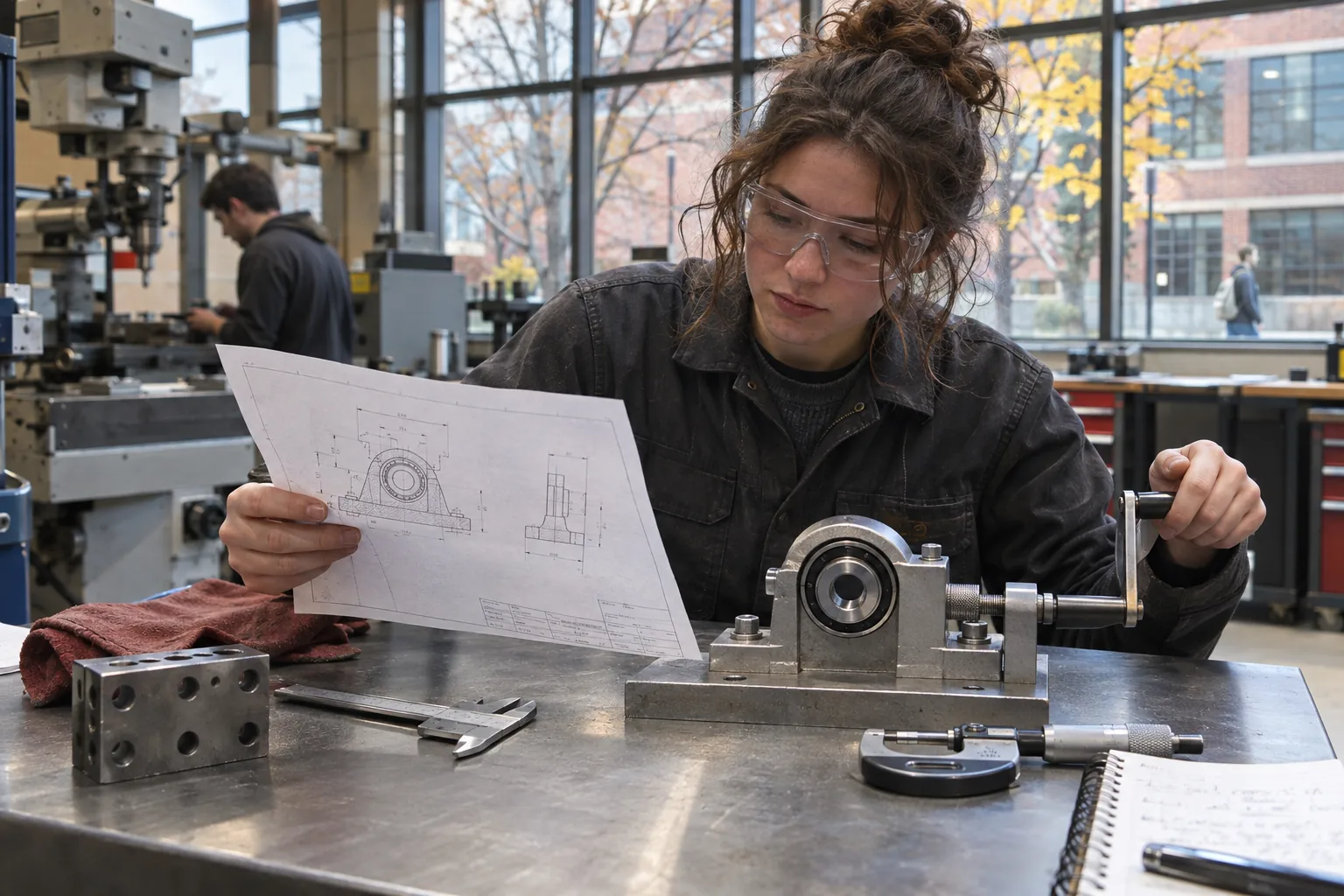
A shaft, a housing and a bearing may look straightforward on a drawing. Their relationships are less forgiving when a real assembly has to carry a load. Mechanical Engineering Technology connects the geometry, material and manufacturing decisions behind that result.
The pathway combines applied physics and calculus with drawing, materials, manufacturing and test methods. Students learn to show how an analysis informed a component and how an inspection or repeated trial supports the decision to keep or revise it.
Read the load
Use a clear mechanical model to connect forces, constraints and component behavior.
Plan the process
Choose materials and fabrication steps that can achieve the intended geometry.
Check the result
Document dimensions, repeat a test and explain the limits of the measurement.
A project with a useful question.
A hand-powered bearing fixture gives a team a bounded mechanical problem. Students define how a sample is supported, prepare the assembly drawings and compare repeated observations before deciding whether the fixture is useful. A polished part without a measurement record is not the end of the exercise.
See student project records for methods, advisers and the evidence each team prepares.
The places behind the pathway.
North Works connects supervised fabrication with an inspection position. Kepler classrooms support the analysis and drawings that precede workshop work. Students complete the relevant induction and equipment authorization before a teaching session.
2026–27 catalog / sample sequence
Your four-year course map.
The 124-credit degree combines 30 general-education credits, 30 foundation credits, 24 required major credits, 18 concentration electives and 18 free electives plus four one-credit practice labs.
The sample concentration selection is published below as actual courses. Free electives are adviser-approved, unduplicated college-level work with prerequisites met. Transfer review and actual class availability can change an individual sequence.
Year 131 credits
Fall semester
Spring semester
Year 232 credits
Fall semester
Spring semester
Year 331 credits
Fall semester
Spring semester
Year 430 credits
Fall semester
Spring semester
Eight courses that define the major.
Each course builds on documented prerequisites. The proposal and implementation capstones sit in the final fall and spring terms.
MET210 · Statics and Strength of Materials
Model loads, reactions, stress and deformation in simple components. Students communicate assumptions and compare analytical results with test observations.
MET220 · Manufacturing Processes
Compare machining, forming, joining and additive processes. Planning exercises connect material choice, tolerances and production constraints.
MET310 · Machine Elements
Select shafts, bearings, fasteners and transmission elements for a mechanical assembly. Students document loads, factors of safety and component decisions.
MET320 · Thermal and Fluid Systems
Apply energy balances and basic fluid principles to practical systems. Case work examines pumps, heat transfer and performance measurements.
MET330 · Computer-Aided Manufacturing
Translate a part model into a manufacturing plan and simulated toolpaths. Students check workholding, process sequence and inspection requirements.
MET340 · Mechanical Test Methods
Design a repeatable test and interpret mechanical performance data. Reports address measurement limits, variation and engineering recommendations.
MET401 · Mechanical Capstone I
Define a mechanical design brief, compare concepts and prepare an analysis-backed proposal. Teams review requirements before fabrication begins.
MET402 · Mechanical Capstone II
Build and evaluate the proposed mechanical solution. Teams document revisions, test results, manufacturing records and a final technical review.
Prepare for the next step.
Algebra, clear writing and experience explaining how a project works. Calculus readiness is reviewed for engineering and data pathways.
Required courses need a grade of C or better and graduation requires a 2.0 cumulative GPA. At least 30 of the final 45 credits and both capstones are completed at Larkmere. An adviser can explain the distinction between a transferable course and one that satisfies a particular requirement.
Possible directions include Mechanical engineering technologist, manufacturing technologist, mechanical test specialist. These are study-to-work directions, not guaranteed placements. Career Development helps students select portfolio evidence and explain their individual contribution.