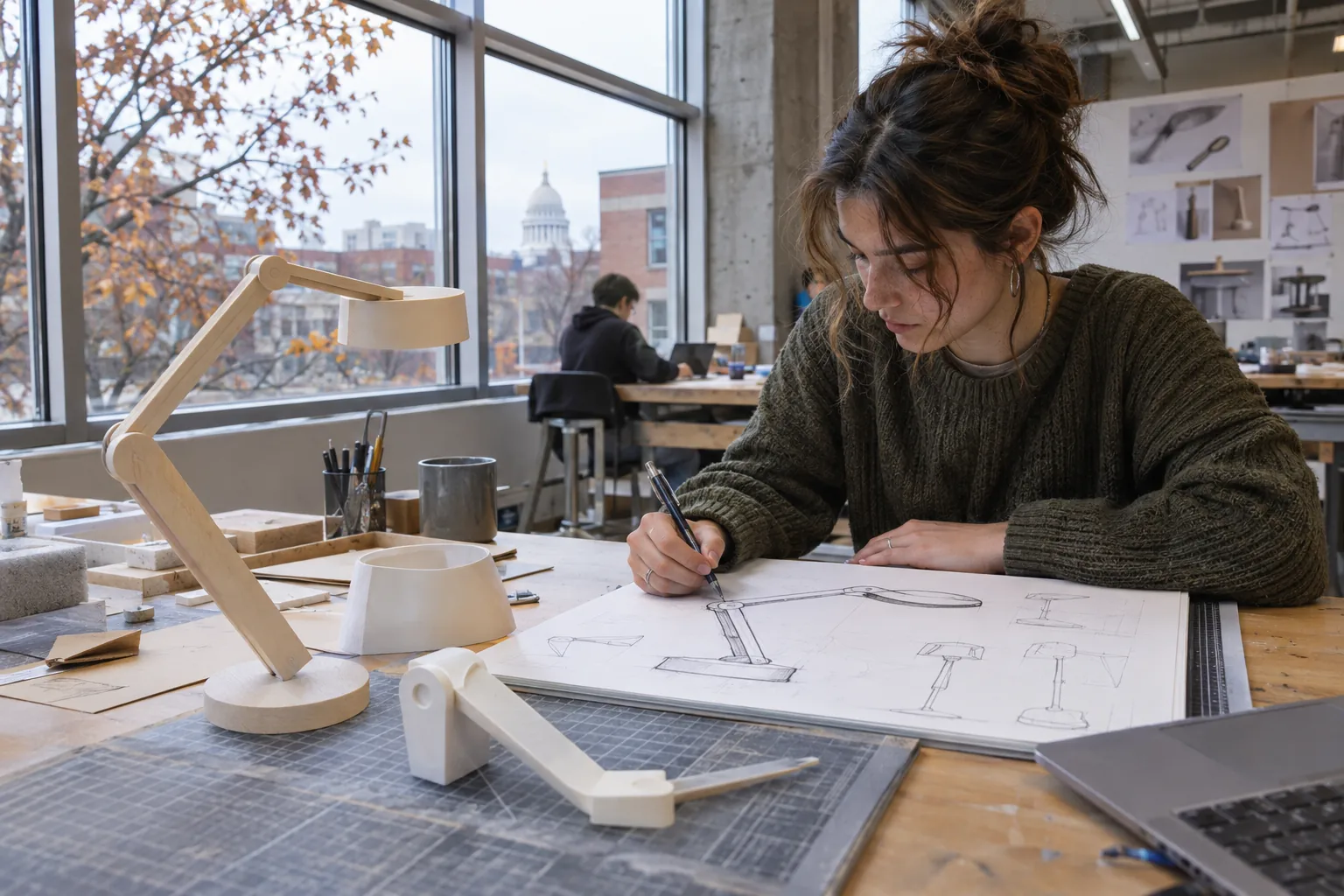
A discipline you can put to work.
An object carries decisions about a person’s hand, a material, a manufacturing process and the time when a part might need replacing. Industrial Design makes those decisions a subject for observation, sketching, physical models and critique.
Design foundations and technical drawing lead into product form, prototyping, research and development studios. Students move between the appearance of an idea and the evidence that it can be held, assembled, used or revised in the way proposed.
Observe the task
Use research to define a product brief with a specific human purpose.
Make alternatives
Develop form and assembly relationships through sketches and physical models.
Evaluate a prototype
Connect test observations with material and production decisions.
A project with a useful question.
A repairable task light explores what happens after a switch or cable wears out. Separable parts, common fasteners and an accessible assembly sequence become questions to test, not automatic proof of commercial readiness.
See student project records for methods, advisers and the evidence each team prepares.
The places behind the pathway.
Studio Annex provides daylight worktables, critique areas and supervised digital fabrication. The 124-credit pathway includes four one-credit practice labs, including introductory measurement and electronics bench work that supports product prototypes.
2026–27 catalog / sample sequence
Your four-year course map.
The 124-credit degree combines 30 general-education credits, 30 foundation credits, 24 required major credits, 18 concentration electives and 18 free electives plus four one-credit practice labs.
The sample concentration selection is published below as actual courses. Free electives are adviser-approved, unduplicated college-level work with prerequisites met. Transfer review and actual class availability can change an individual sequence.
Year 131 credits
Fall semester
Spring semester
Year 232 credits
Fall semester
Spring semester
Year 331 credits
Fall semester
Spring semester
Year 430 credits
Fall semester
Spring semester
Eight courses that define the major.
Each course builds on documented prerequisites. The proposal and implementation capstones sit in the final fall and spring terms.
IND210 · Product Sketching and Form
Develop product concepts through sketching, proportion studies and physical form models. Students use critique to connect appearance with intended function.
IND220 · Model Making and Prototyping
Choose materials and methods for exploratory product models. Supervised studio work emphasizes tool training, accuracy and iteration.
IND310 · Product CAD and Surfaces
Build detailed product models and resolve surfaces, assembly relationships and drawings. Students prepare models for review and prototype production.
IND320 · Materials and Production for Design
Compare production methods and material choices for manufactured objects. Students revise a product concept for a specified process and volume.
IND330 · Design Research Methods
Plan observation, interviews and evaluative research for a product brief. Students synthesize findings without overstating a small study.
IND340 · Product Development Studio
Develop a product from research through prototypes and testing. Reviews connect user needs, material decisions and manufacturing constraints.
IND401 · Industrial Design Capstone I
Define a product opportunity and develop a research-backed concept. Students prepare form studies, requirements and a prototype evaluation plan.
IND402 · Industrial Design Capstone II
Refine, prototype and assess a product proposal. Final presentations include a process record, physical model and production considerations.
Prepare for the next step.
Algebra, clear writing and experience explaining how a project works. Calculus readiness is reviewed for engineering and data pathways.
Required courses need a grade of C or better and graduation requires a 2.0 cumulative GPA. At least 30 of the final 45 credits and both capstones are completed at Larkmere. An adviser can explain the distinction between a transferable course and one that satisfies a particular requirement.
Possible directions include Industrial designer, product development associate, prototype specialist. These are study-to-work directions, not guaranteed placements. Career Development helps students select portfolio evidence and explain their individual contribution.