A discipline you can put to work.
An electrical system has to be understood at more than one scale. A sensor produces a signal, a circuit changes it and a controller or display makes it usable. This pathway connects those relationships through analysis, supervised bench work and documented integration.
Students move from electrical and physics foundations into analog electronics, digital logic, machines, power conversion and instrumentation. Measurement remains central: expected behavior is compared with actual results rather than inferred from a circuit that happens to operate once.
Analyze a circuit
Relate component choices and operating conditions to a predicted response.
Build a measurement chain
Select sensing, conditioning and acquisition methods with explicit limits.
Integrate and explain
Check interfaces and provide a wiring, program and test record others can follow.
A project with a useful question.
A low-voltage energy-monitor demonstrator brings a reference meter, sensing chain and operator display into the same project. The team checks calibration, documents the connection between readings and units, and evaluates whether the enclosure and display make the result understandable.
See student project records for methods, advisers and the evidence each team prepares.
The places behind the pathway.
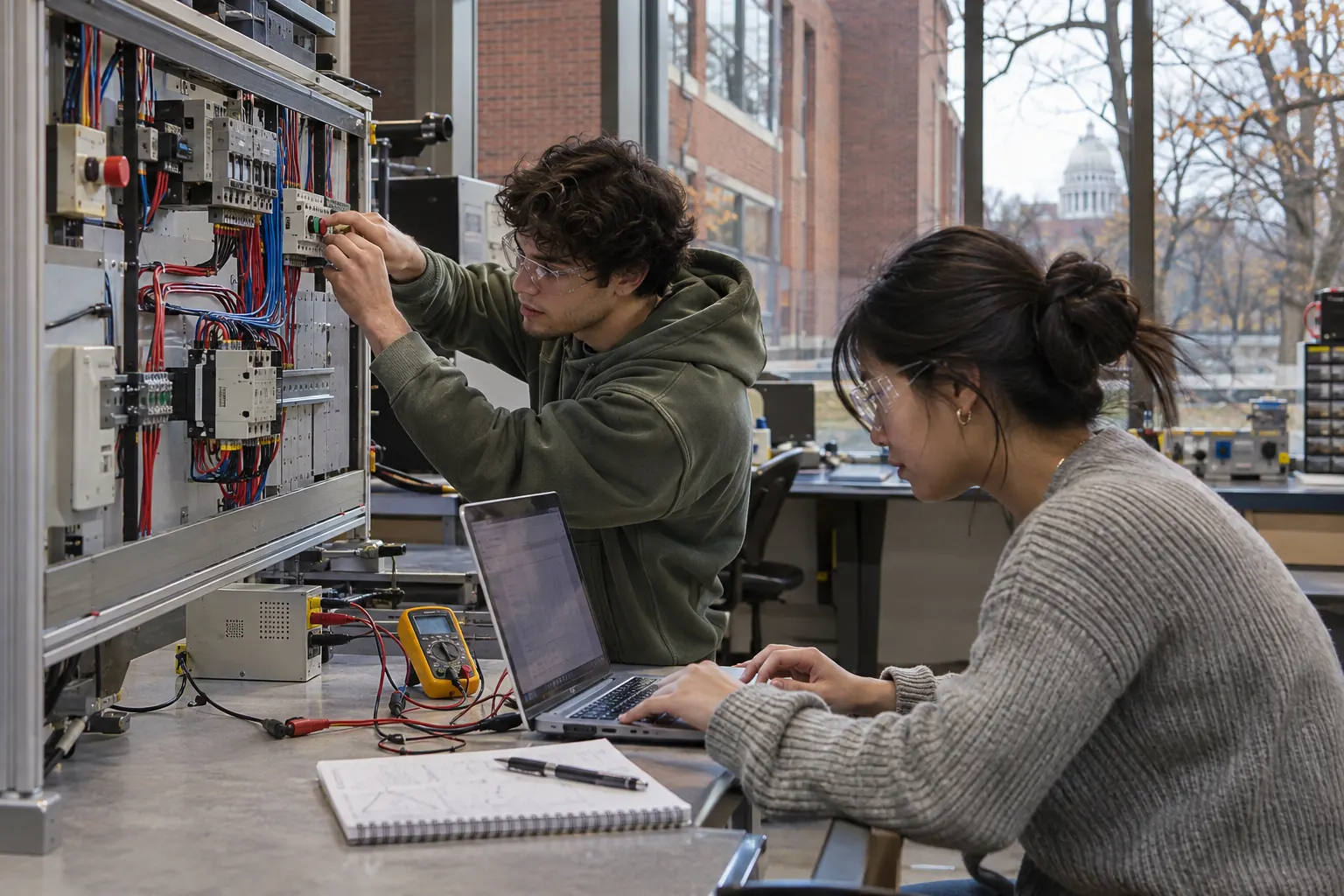
Kepler teaching benches support low-voltage measurement and embedded exercises. Selected fabrication sessions in North Works help students prepare an enclosure or fixture. All electrical and equipment tasks remain within an approved, supervised teaching setup.
2026–27 catalog / sample sequence
Your four-year course map.
The 124-credit degree combines 30 general-education credits, 30 foundation credits, 24 required major credits, 18 concentration electives and 18 free electives plus four one-credit practice labs.
The sample concentration selection is published below as actual courses. Free electives are adviser-approved, unduplicated college-level work with prerequisites met. Transfer review and actual class availability can change an individual sequence.
Year 131 credits
Fall semester
Spring semester
Year 232 credits
Fall semester
Spring semester
Year 331 credits
Fall semester
Spring semester
Year 430 credits
Fall semester
Spring semester
Eight courses that define the major.
Each course builds on documented prerequisites. The proposal and implementation capstones sit in the final fall and spring terms.
EST210 · Analog Electronics
Analyze amplifiers, filters and basic semiconductor circuits. Students use simulation and supervised bench measurements to evaluate circuit behavior.
EST220 · Digital Logic and Embedded Systems
Design digital logic and program a small embedded controller. Exercises connect input signals, timing, outputs and fault diagnosis.
EST310 · Electrical Machines and Drives
Compare motors, generators and drive arrangements. Coursework examines performance curves and supervised low-energy teaching demonstrations.
EST320 · Power Systems and Energy Conversion
Study generation, conversion, distribution and load behavior through models and training equipment. Students evaluate efficiency and protection concepts.
EST330 · Electronic Instrumentation
Build a measurement chain using signal conditioning and data acquisition. Reports compare expected and measured response over a defined operating range.
EST340 · Electrical Systems Integration
Connect sensing, control and electrical subsystems in a documented prototype. Students develop wiring records, interface checks and troubleshooting plans.
EST401 · Electrical Capstone I
Develop requirements and a verified design proposal for an electrical system. Reviews address interfaces, measurement plans and operating limitations.
EST402 · Electrical Capstone II
Assemble and evaluate the proposed electrical system under supervision. Teams present test evidence, design changes and complete technical documentation.
Prepare for the next step.
Algebra, clear writing and experience explaining how a project works. Calculus readiness is reviewed for engineering and data pathways.
Required courses need a grade of C or better and graduation requires a 2.0 cumulative GPA. At least 30 of the final 45 credits and both capstones are completed at Larkmere. An adviser can explain the distinction between a transferable course and one that satisfies a particular requirement.
Possible directions include Electrical engineering technologist, instrumentation specialist, systems test technologist. These are study-to-work directions, not guaranteed placements. Career Development helps students select portfolio evidence and explain their individual contribution.