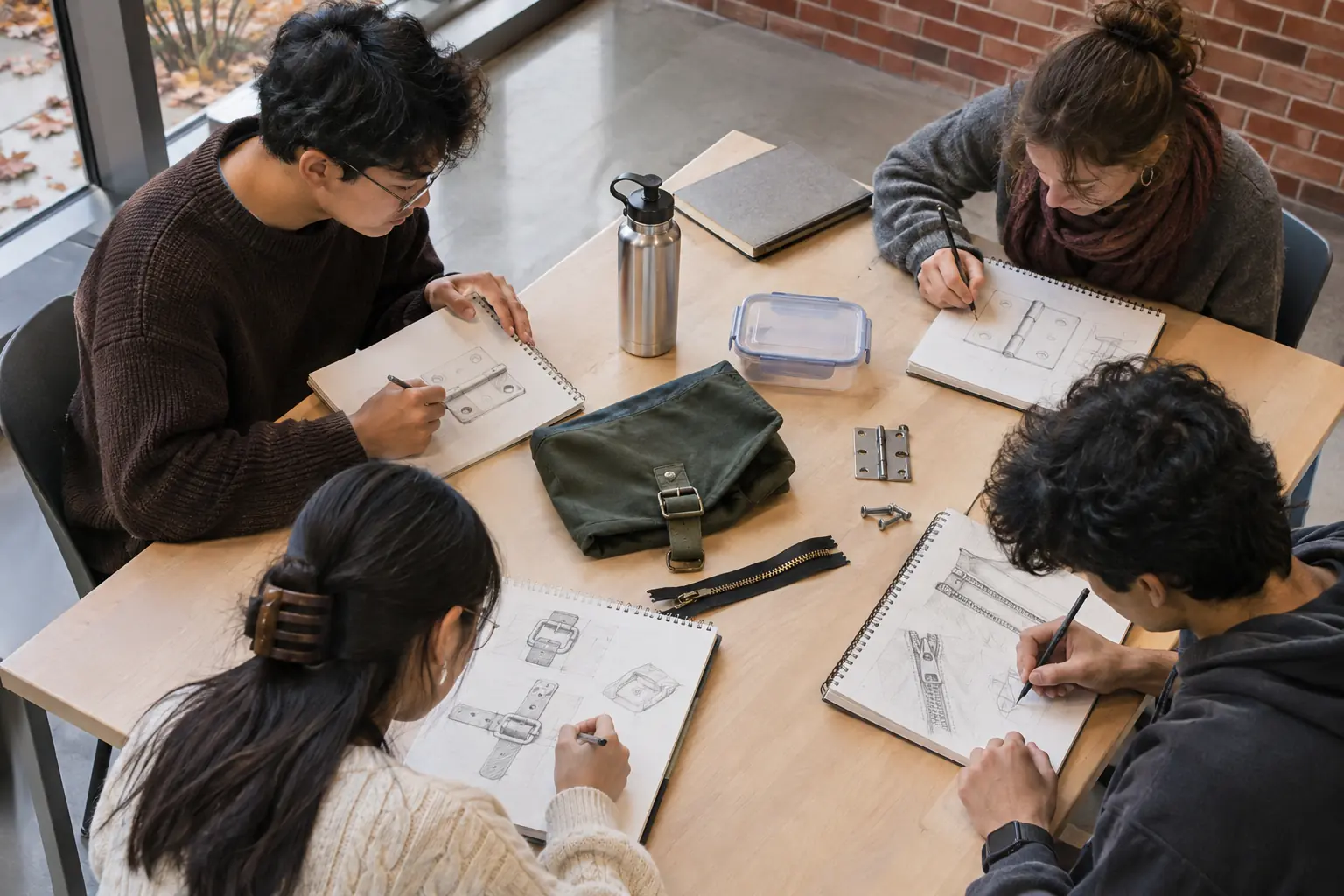
At the first Design Exchange meeting of the term, students sketched the seams, fasteners and moving parts of familiar objects. The exercise asked them to describe how something was assembled before proposing how it might be improved.
Describe before redesigning.
At the first Design Exchange meeting of the fall term, familiar objects became subjects for close observation. Students looked for seams, fasteners, moving parts and the relationship between an outside surface and the assembly behind it.
Aisha Turner began with sketches rather than a proposal for a finished replacement. Drawing a joint or a cover requires a student to decide what has actually been observed and what is still an assumption. The exercise made room for both kinds of note.
The objects were unpowered and appropriate for a supervised tabletop activity. The group was not offering certified repair advice or attempting a live equipment demonstration. Its task was to describe how something appeared to be assembled before claiming how it should be changed.
Compare how parts meet.
A visible fastener can suggest one kind of access, while a hidden joint can raise another set of questions. Students compared the order in which a part might be removed, the space a tool would need and the way an assembly could be supported during a task.
Professor Helen Park encourages that attention to a sequence. A product is not only the form seen in a photograph. It is also a set of relationships that appear when someone uses it, assembles it or returns to it after a component wears out.
The meeting kept those observations in a shared record of sketches and questions. A drawing that did not yet resolve a detail could still help another participant see the uncertainty. In critique, a clear question can be more productive than a confident redesign with no evidence behind it.
Keep the inquiry open.
Design Exchange is a student organization, separate from a required studio assessment. It gives learners a regular place to compare work, practice explanation and encounter a viewpoint from another course or pathway. Both physical product and interface questions can benefit from that exchange.
The group meets on Thursdays, 5–6:30 p.m., in Studio Annex S104. Participation in a club does not provide automatic authorization for fabrication equipment. Any activity involving a teaching tool follows the relevant training and supervision arrangements.
For students like Turner, the sketches can become a habit carried into later projects: look at the actual object, describe a task, compare an alternative and keep enough of the process for another person to follow. The next design decision begins with a better account of what is already there.