Robotics Collective
Develops small pick-and-place demonstrations and keeps a shared test log.
Meet: Wednesdays 5–6:30 p.m., supervised teaching cell
Place: North Works
Adviser: Dr. Nathan Ortiz
Life
Student groups give a project, a shared interest or a practical campus question a regular place in the week.
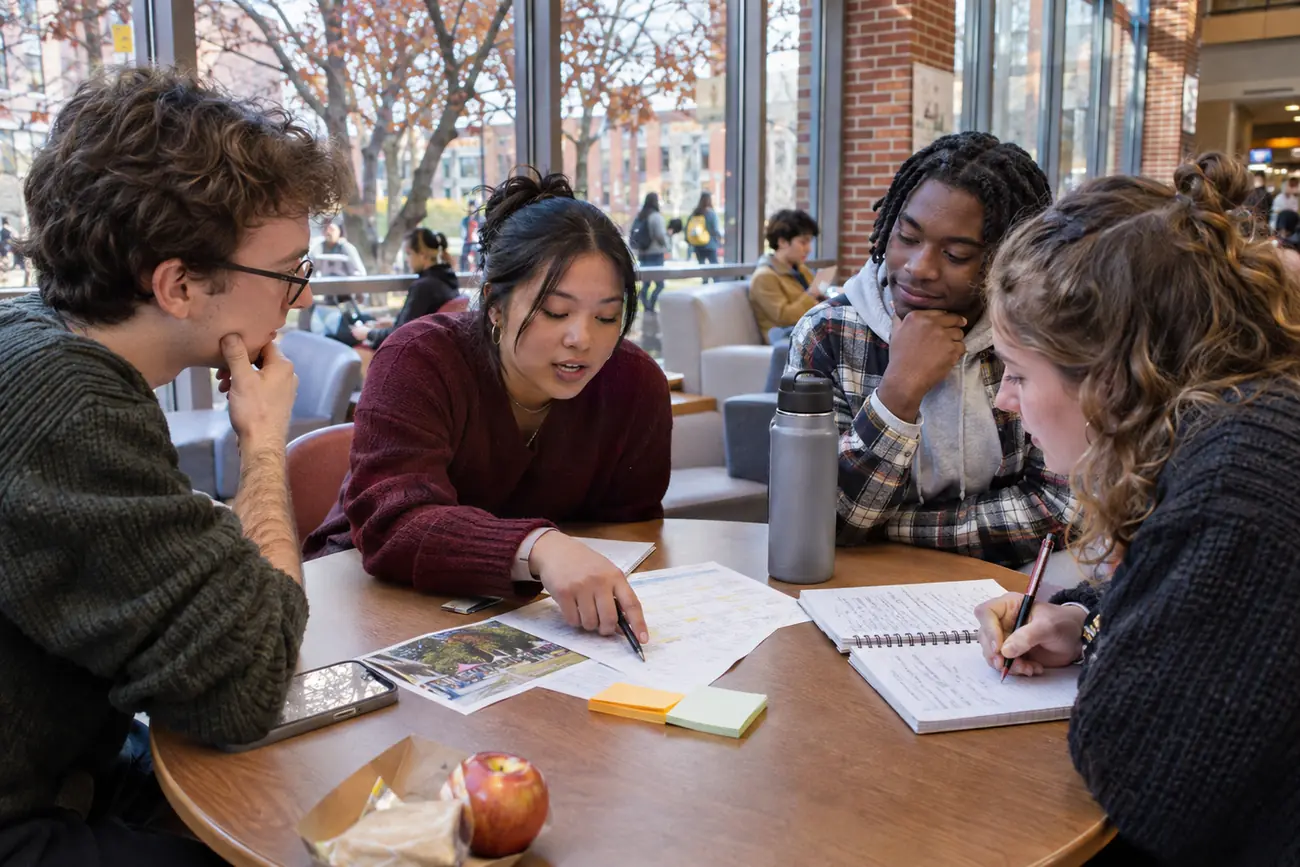
A club can connect coursework with a different kind of conversation. Students compare a sketch, examine a small dataset, plan a demonstration or raise a practical question about the campus day. The activity can begin with curiosity rather than a finished project.
The groups below list their regular teaching-term meeting pattern. Ask Student Life about a current meeting or access arrangement before relying on a date during a break. Clubs do not automatically grant equipment permissions.
Develops small pick-and-place demonstrations and keeps a shared test log.
Meet: Wednesdays 5–6:30 p.m., supervised teaching cell
Place: North Works
Adviser: Dr. Nathan Ortiz
Hosts sketch exchanges, repair critiques and prototype reviews.
Meet: Thursdays 5–6:30 p.m., S104
Place: Studio Annex
Adviser: Professor Helen Park
Builds charts from public or approved teaching data and reviews methods together.
Meet: Tuesdays 5–6 p.m., V208
Place: Vector Computing Center
Adviser: Dr. Marcus Chen
Practices defensive scenarios on the isolated campus teaching range.
Meet: Wednesdays 5–6 p.m., V214
Place: Vector Computing Center
Adviser: Dr. Priya Menon
Collects commuter feedback and plans lunchtime campus events.
Meet: First Thursday monthly, noon–1 p.m., U104
Place: Union House
Adviser: Erin Wallace
Organizes casual walks, cycling meetups and equipment information sessions.
Meet: Second Tuesday monthly, noon–1 p.m., U106
Place: Union House
Adviser: Erin Wallace
Bring Student Life a short description of the interest, a student organizer and a possible staff adviser. Explain the kinds of meetings or activities you want to hold and the space they need. A practical, bounded proposal is easier to review than a promise of a large event before the details exist.
Any activity involving a teaching tool or controlled environment still follows the relevant induction, authorization and supervision. A lunchtime planning meeting and an equipment session need different arrangements.
Several groups meet at noon, including the Commuter Council and Campus Outdoors. Others use early evening times that fit a teaching-space schedule. Consider the actual meeting pattern alongside your classes and travel rather than assuming participation requires staying late every day.
Start with a conversation. Come see the work.