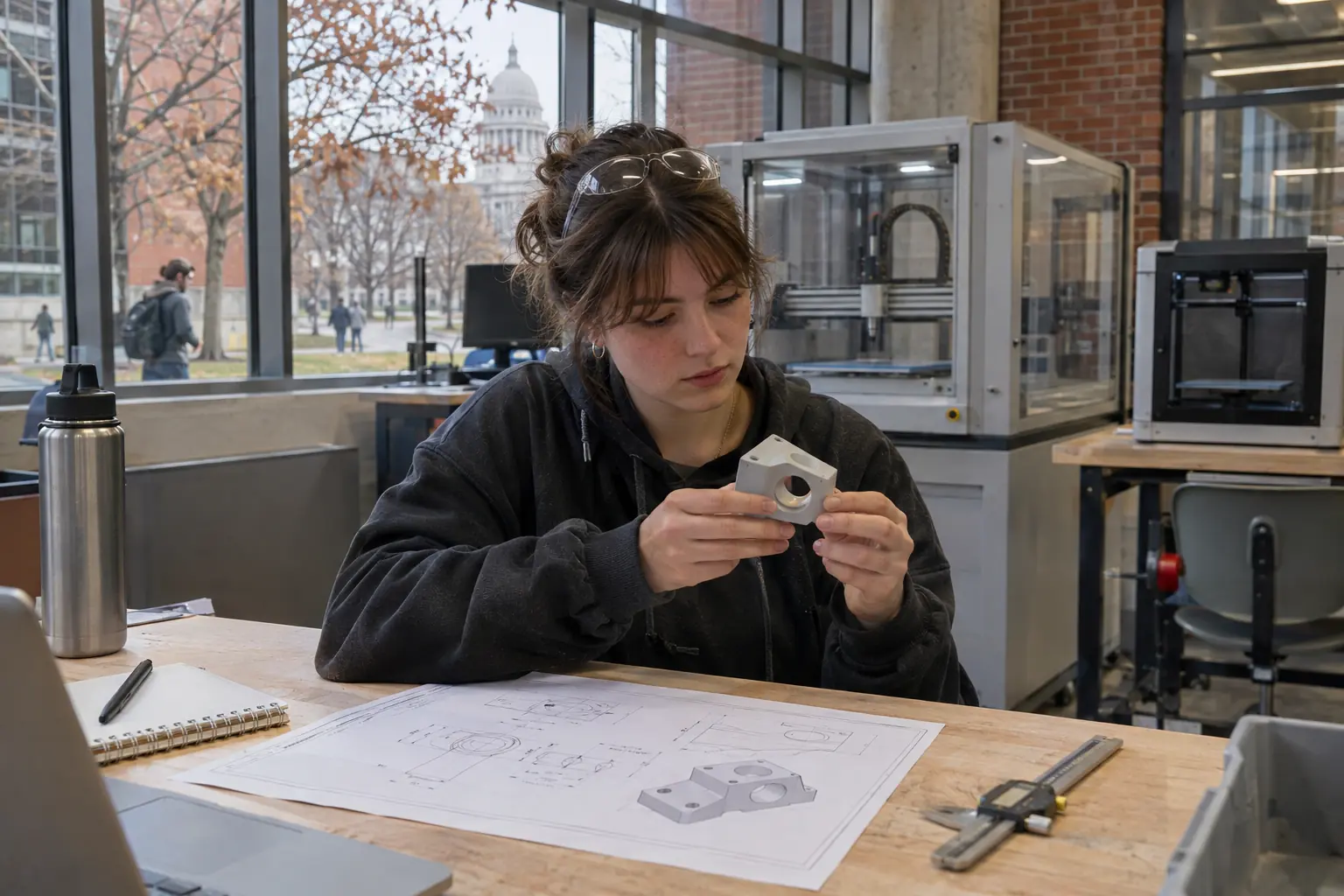
A focused sequence, with a clear output.
Prepare drawings and process records, fabricate a prototype and evaluate dimensional results.
This is an undergraduate credit certificate. It can support a degree plan or a nondegree learner’s defined goal, but it is not a substitute for all the breadth and advanced work in a bachelor’s degree. The same course prerequisites apply to both groups.
The courses, in order.
The 18-credit sample below begins with introductory preparation and normally spans three teaching terms. A learner with approved prior coursework may have a different plan. Each term builds on work completed before it.
Term 1
9 credits
Use sketching, form, composition and iterative making to explore a design problem. Students document alternatives and reflect on critique.
Create dimensioned drawings and parametric models for technical communication. Students check geometry, tolerances and drawing conventions.
Compare metals, polymers, ceramics and composites through properties and processing methods. Selection exercises relate performance to intended use.
Term 2
6 credits
Choose materials and methods for exploratory product models. Supervised studio work emphasizes tool training, accuracy and iteration.
Compare machining, forming, joining and additive processes. Planning exercises connect material choice, tolerances and production constraints.
Term 3
3 credits
Translate a part model into a manufacturing plan and simulated toolpaths. Students check workholding, process sequence and inspection requirements.
Entry and attendance.
High-school completion or equivalent; college algebra readiness where required. Degree-seeking and nondegree learners use the same course prerequisites.
In-person studios and supervised labs; normally three terms. Sessions use actual classrooms, studios and labs; the certificate is not advertised as an entirely online or evening sequence. Before registering, review the available sections with an adviser and discuss any course-specific materials or access needs.
Plan the published cost.
At $1,240 per credit, 18 credits cost $22,320 in tuition. Three enrolled terms at $180 per term add $540 in services fees. The illustrated tuition-and-services total is $22,860, before books, materials, travel or living costs.
These are 2026–27 reference rates. The actual number of credits and enrolled terms can change after transfer review. Annual degree merit scholarships do not apply to certificate-only enrollment; ask Student Accounts about the applicable published charges.
Completion and a later degree.
Earn C or better in every listed course; no course is counted twice within this certificate.
Courses may also satisfy a degree requirement when approved. Credits are not added a second time to the degree total.
Keep the completed course record and meet an adviser before assuming that a certificate shortens a particular degree by the full certificate total. Applicability depends on the degree’s categories, residency rule and remaining sequence.