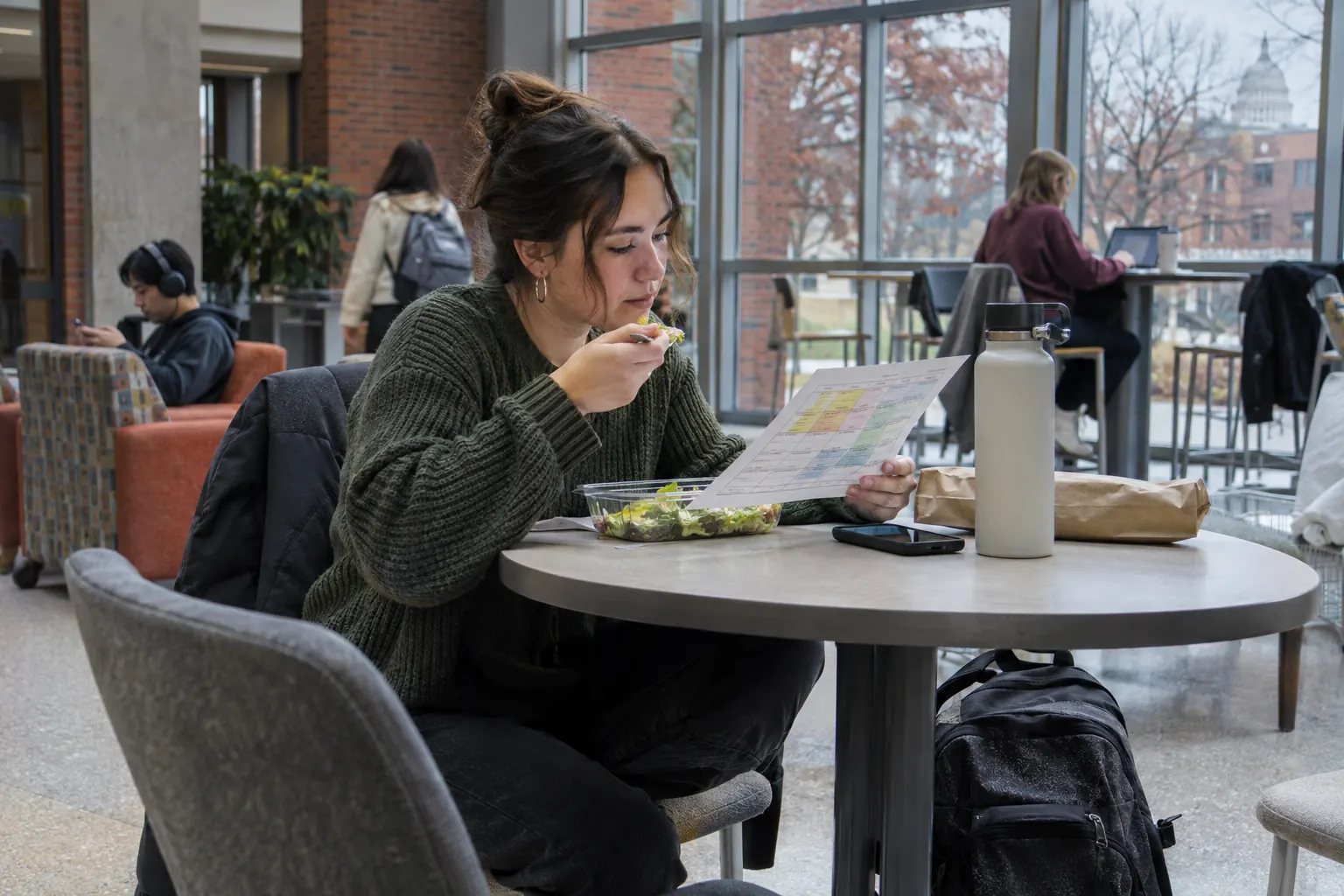
For commuter students, a useful campus space can be the place to warm lunch, charge a laptop and finish a reading before the next class. The Commuter Council is collecting small, practical suggestions for Union House U104.
A home base during the day.
Devon Clark’s campus day does not end when one class finishes. There may be another session after lunch, a project conversation to arrange or a short task worth completing before the trip home. Union House U104 gives that interval somewhere to happen.
The commuter lounge is open Monday–Friday, 7 a.m.–9 p.m. Students use tables, charging points and a microwave, with lockers requested through Student Life as availability allows. It is an ordinary shared space rather than a residence substitute or a reserved private workspace.
For commuter students, those practical details can shape whether a gap is useful. A place to put a bag, heat a brought lunch or sit down with a reading can matter as much as another formal activity. The Commuter Council is gathering observations about that everyday experience.
Look before proposing a change.
Clark brings a user-experience perspective to a familiar setting. Before deciding what a campus service should add, it helps to describe the task someone is trying to complete. Finding an opening time and locating an available table are different problems, even when they happen during the same hour.
The council’s conversations focus on small, practical suggestions. They are not an announcement of a renovation budget or a promise that every requested change will be made. Student Life helps connect a question with the office that can examine it.
Erin Wallace, Director of Student Life, coordinates commuter programs alongside student organizations and residence-life staff. That connection lets a lunchtime question become part of a broader campus conversation without requiring a student to stay late for every meeting.
Find a way to take part.
The Commuter Council meets at noon on the first Thursday of each month in U104. Learners can bring an observation, hear how another student uses the space or ask how to connect with a group. A regular time makes it possible to plan participation around a daytime schedule.
Other parts of the campus support the same routine. Union dining offers a weekday lunch window from 11 a.m.–2 p.m.; Mercer Library provides study space and appointments; advising helps students check the course sequence before registration. None of those services needs to be used in exactly the same way by every commuter.
The starting point is an ordinary day. A useful campus service should make that day easier to understand and navigate. By paying attention to the hour between classes, students and staff can identify a question small enough to discuss and practical enough to act on.