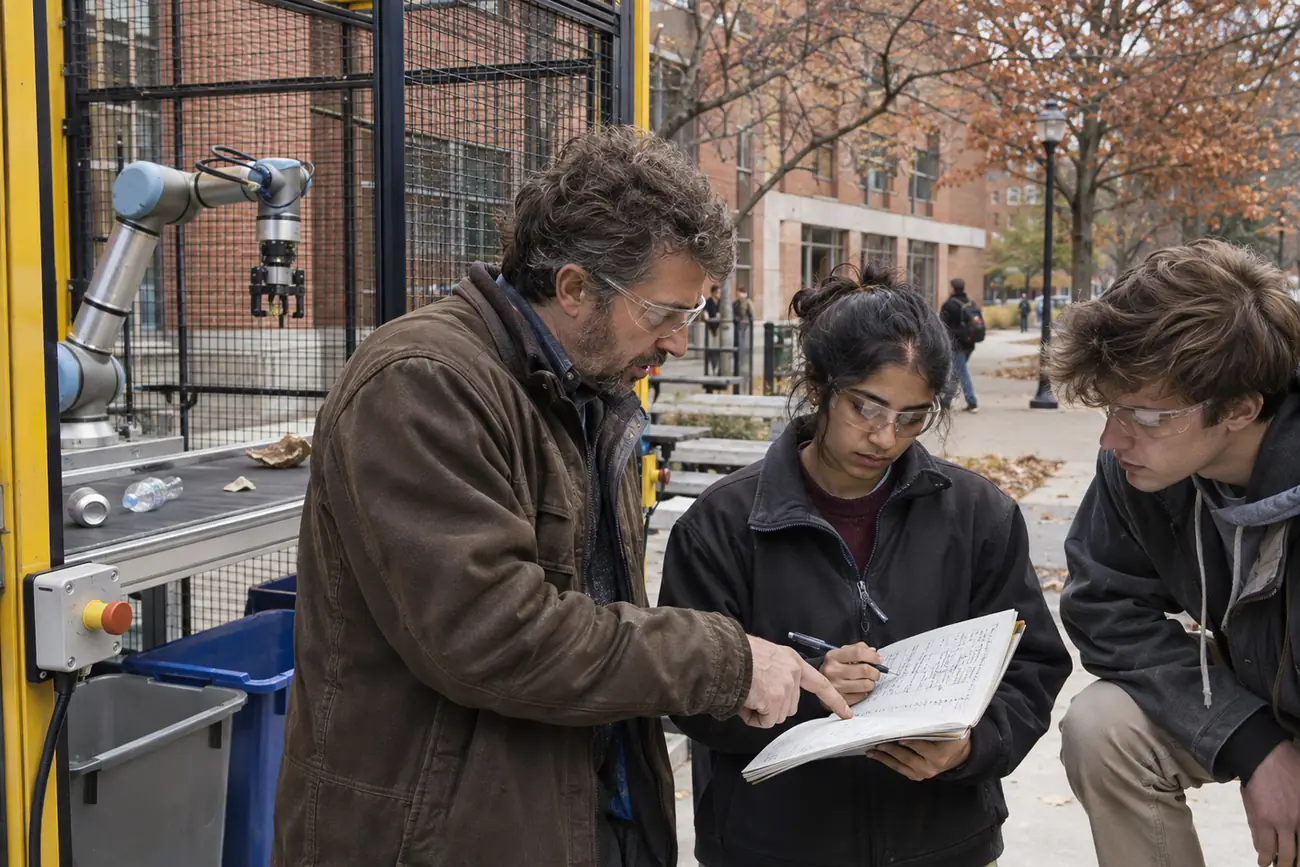
Students working in a guarded teaching cell compared two ways to recognize small sample parts. Instead of beginning with speed, they recorded lighting, part orientation and missed detections so that each change could be traced to a result.
Build a useful baseline.
Inside a guarded cell at North Works, sample parts give Maya Bennett and Ethan Ross a task that is simple to describe and less simple to repeat. A part is presented, an inspection decision is made and the robot attempts the next step. The students are recording what happens before deciding what to improve.
Their first question is not how quickly the demonstration can run. It is whether a result can be traced to a known set of conditions. The team notes the part orientation and the lighting, then compares the recorded trial with the intended operating sequence. A missed detection stays in the log.
The exercise connects work in Industrial Robotics with the integration and reliability questions that follow later in the pathway. Students have to describe the controller inputs, the sensing decision and the movement that depends on it. A successful cycle is useful evidence only when the team can explain the sequence that produced it.
Change a single condition.
A camera-based inspection and a simpler sensor arrangement provide different ways of answering a bounded question about the part. Neither is treated as the automatic choice. The team considers what each approach can detect, what needs to be held constant and how an error would appear in the record.
Changing lighting and part orientation together might produce a better-looking run while leaving the explanation uncertain. Instead, Bennett and Ross compare one condition at a time. They keep the earlier observations so that a proposed improvement can be checked against a baseline rather than a memory of how the cell seemed to behave.
Dr. Nathan Ortiz uses the review to connect a practical demonstration with an engineering argument. The operating sequence, the interface map and the test notes should describe the same system. If they disagree, the mismatch is a question for the next supervised session, not a detail to hide in a final presentation.
Document the limits.
The cell is a teaching environment using sample parts. It has no commercial production target, and the exercise does not establish an industrial throughput or reliability claim. The team reports its conditions and the limits of its trials alongside any result.
All movement takes place inside the guarded area during authorized instruction. Students operate from the designated position and discuss a change before it becomes part of a trial. The preparation is as much a feature of the lesson as the robot itself.
The next useful answer may be a revised detection method, a clearer record or a smaller claim about what the demonstration can do. In each case, students leave with a method they can explain: establish a baseline, change a condition, inspect the evidence and decide what still needs testing.