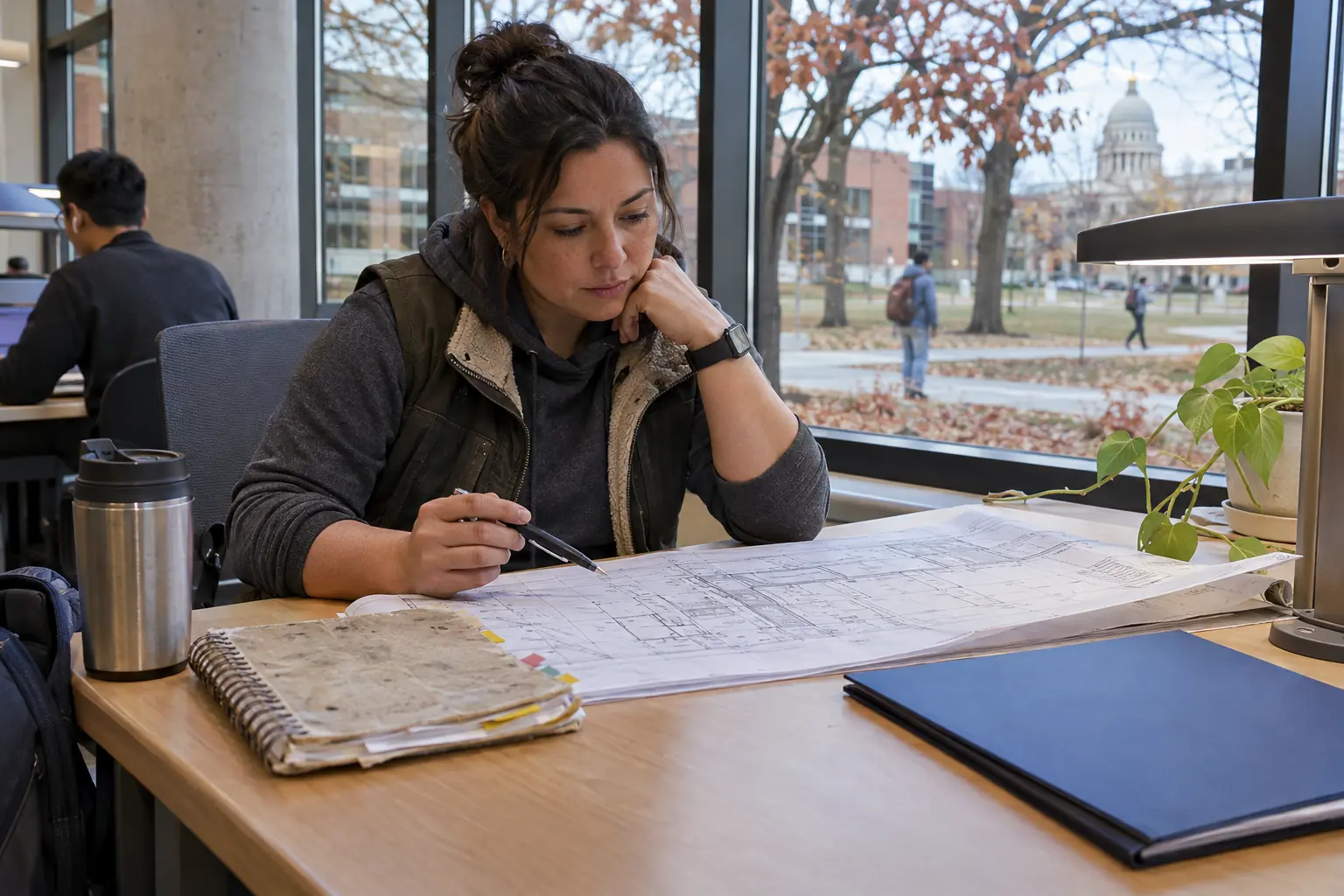
After several years in a site-support role, construction management student Lena Morris returned to study with a notebook of questions about schedules and drawings. Advising helped turn those questions into a manageable first-term course plan.
Start with the records already earned.
Lena Morris returned to study with a notebook of questions about the relationship between a drawing and a site schedule. Several years in a site-support role had given her situations to think about. The Construction Management pathway offered a way to examine them through formal methods and a connected course sequence.
Her first planning task was gathering academic records. Transfer review considers the content and applicability of previous courses, not simply the number of credits on a transcript. A course that has transferable value may still leave a specialist prerequisite or a later project requirement to complete.
Faculty review and advising helped distinguish those questions before registration. The resulting first-term plan was based on the learning already documented and the work still needed. Employment experience informed the conversation; it was not automatically converted into academic credit.
Plan around actual class times.
Returning to a degree also meant planning a real campus day. Larkmere’s construction courses use daytime teaching and in-person project activities. Morris considered the time for class, preparation and the work between sessions rather than assuming that every requirement could fit an evening-only route.
The commuter lounge in Union House provides a useful base for part of that day. A table, a meal and somewhere to organize notes can make the gap between classes productive. Mercer Library and tutoring appointments add other options for work that needs a quieter setting or a second explanation.
Dr. Rachel Brooks’s advising discussion connects scheduling with academic sequence. Documents, estimating and planning courses build on earlier work. The published eight-semester map helps explain those relationships, while an individual plan reflects transfer decisions and actual course availability.
Connect experience with a method.
In a teaching project, a familiar construction question has to be made explicit. A student may recognize that a change will affect the work, but the course asks for a record of which quantities, dependencies or resources change and how that affects the proposed plan.
That step from recognition to explanation is part of the reason Morris returned. A notebook of practical questions becomes a starting point for a drawing review, an estimate or a schedule exercise. The goal is not to replace experience with a formula, but to make a decision clear enough for someone else to assess.
This is one student’s route, not a promise that every returning learner will follow the same timetable or receive the same transfer result. Admissions and academic advisers encourage prospective students to bring their records and schedule questions early, so that the commitment is based on the pathway actually available.