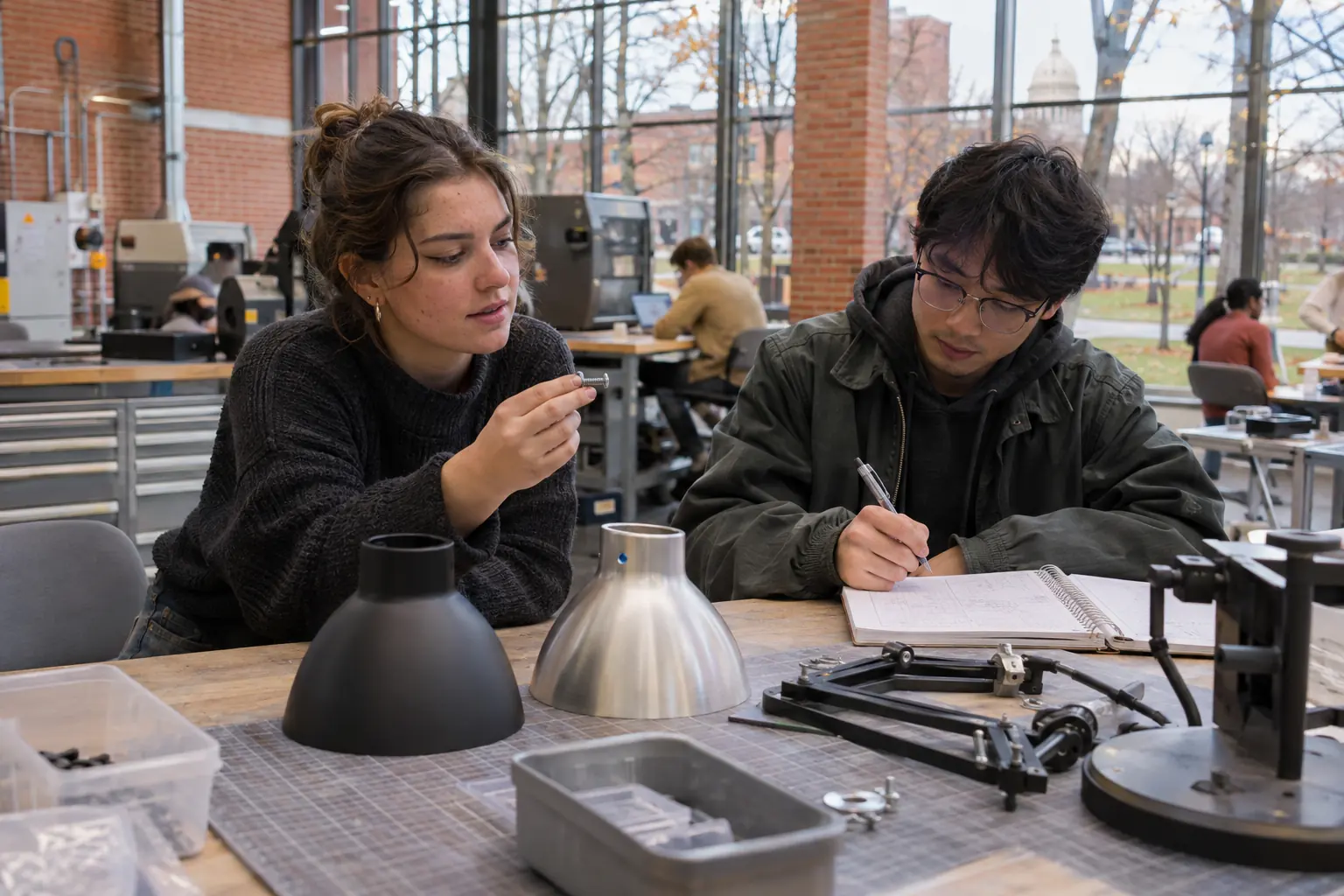
Jonah Miles and Aisha Turner began their task-light study with a question about what happens after a switch or cable wears out. Their latest prototype makes the assembly part of the design.
On a worktable in Studio Annex, a shade sits beside a base, a short list of fasteners and several pages of assembly notes. The arrangement is deliberate. Before the industrial design students decide how the light should look as a finished object, they are working out how its parts should come apart.
The exercise belongs to Product Development Studio, where research, physical models and evaluation are expected to inform each other. The task light is a teaching prototype, not a product offered for sale. Its value lies in the decisions students can explain and the questions the next version makes possible.
Start with the repair task.
Miles and Turner looked at the places where an ordinary maintenance task becomes difficult: a cable path hidden behind an inaccessible part, a cover that depends on a fragile clip, a fastener that requires an uncommon tool. These observations gave them a more precise brief than simply making a new lamp shape.
Three form models preceded the current bench prototype. Each let the pair examine a different relationship among the shade, support and base. The models did not have to resolve every detail at once. A rough shape could answer a question about reach or proportion before a more developed assembly was needed.
Professor Helen Park uses that progression to keep a project grounded in evidence. In the studio, a convincing presentation has to be accompanied by the model, observation or test that led to a decision. A drawing can make an idea clear, but a physical trial often reveals where the explanation is incomplete.
in the first design conversation.
Make the assembly visible.
The current version uses a separable shade, an accessible cable path and a small set of common fasteners. Those choices create a sequence that can be documented: what is removed first, which component it reveals and how the assembly goes back together.
The students compared the number and order of steps rather than treating a removable part as proof that the whole object is easy to repair. Their notes record where a hand needs space, which surface supports a component during assembly and where a drawing needs another view. The unpowered prototype allows those relationships to be examined without turning a form study into an electrical test.
Keeping the record alongside the parts also helps a reviewer ask a useful question. A missing instruction or an awkward access point becomes something to revise, rather than a detail hidden by a polished final photograph. It is an example of communication doing technical work.
What the next version needs to show.
The next review will examine stability and the clarity of the assembly record. Those are related concerns: a product has to remain steady in use, and a maintenance sequence has to leave it correctly reassembled. The team will compare the result with the requirements set out in its brief.
The project will continue to change. A successful studio prototype is not the end of the process, and it does not establish commercial readiness or certification. For Miles and Turner, it is a way to make a design claim small enough to test—and clear enough for another person to question.
Across the Industrial Design pathway, this movement between observation, making and evaluation carries into later project work. Students learn to present an object together with its process: the alternatives considered, the constraints accepted and the evidence still needed.